
Fly Rod Buyers Guide Other Fly Fishing Tackle Buyers Guides: - Fly Reel Buyers Guide - Fly Line Buyers Guide
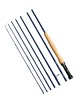
Fly Rods The fly rod is the most important piece of fly fishing tackle you'll buy. The essential things to bear in mind when buying a fly rod are: 1. Fly Rod Price These days you tend to get what you pay for in a fly rod. In our experience you can place fly rods into one of four price brackets:
Low Cost Fly Rods (<£25) These will be fairly basic fly rods, probably glass fiber, that are good for learning or trying the sport at minimal cost. Workhorse Fly Rods(£25 - £75) Good fly rods that will cast well and keep most anglers happy. The more expensive ones will have better fittings. Performance Fly Rods (£75 - £150) Advanced fly rods that tend to be lighter and will cast further and more accurately. The quality is usually very high and if you can afford them these are usually terrific fly rods to use. Delux Fly Rods (£150+) Fly rods in this price range will often be hand made of the finest quality components. They're usually extremely light, have a fast action that is best for experienced anglers and often come with an unconditional warranty. 2. Fly Rod Material Most fly rods these days will be made from carbon fiber. Carbon fiber is stiffer than glass fiber, allowing rods to be thinner, lighter and given a faster action.
Traditional style split cane rods are rare and don't have the qualities most anglers seek from a fly rod. 3. Fly Rod Length The fly rod length should be chosen to suit the style of fishing it will be used for. All else being equal a longer fly rod will generate a higher line speed and cast farther. However it will be heavier, need more force to generate the line speed and be more tiring to use. Our recommendations for fly rod length are: Fly Rods for River Fishing: 9 ft. or less. Long casting isn't the objective here. Choose a lighweight fly rod that will make it easy for lots of short distance casting. Fly Rods for Small Stillwater: 9 ft - 9 ft 6". A good length of fly rod that will accurately cover feeding fish and cast reasonable distances. Fly Rods for Large Stillwater: 9ft 6" - 10ft. Most people will find a fly rod of this length the best for long distance casting. Fly Rods for Boat fishing: 10ft. or longer. The extra length in these fly rods helps keep the line in the air for cleaner casting. 4. Fly Rod (and Line) AFTM number The AFTM (Association of Fishing Tackle Manufacturers) number is a rating given to fly lines to help match the fly rod with the correct line. In essence, each AFTM number is a measure of the weight of the first 30 ft of fly line. The key thing is that the fly line and fly rod rating should match so that the fly rod can cast the fly line properly: | AFTM # | Weight (Grains) | Tolerance | | 4 | 120 | 114-126 | | 5 | 140 | 134-146 | | 6 | 160 | 152-168 | | 7 | 185 | 177-193 | | 8 | 210 | 202-218 | | 9 | 240 | 230-250 | | 10 | 280 | 270-290 | | 11 | 330 | 318-342 | | 12 | 380 | 368-392 |
To convert to metric or ounces: 1 Grain = 0.065 gm = 0.0023 oz The most commonly used line weights in the UK are AFTM #7 or AFTM #8 as these are good all-round lines for stillwater fishing. Lighter weights such as AFTM #6 or less are mostly used for river fishing or where the angler mainly fishes nymphs or dry flies. Heavier lines such as AFTM #9 or higher are mostly used for casting large flies and lures and are sometimes used for salmon fishing. 5. Fly Rod Action Fly rods are often described as having a slow, medium or fast action. The action of a fly rod is effectively it's speed of recovery from being bent and an indication of what style of fishing it is best suited to. A fast actioned fly rod will impart a high line speed to the fly line to cast long distances with tight loops. On the downside however, they can be quite stiff (potentially leading to more line breakages when playing fish) and need better timing to make the most of them. A slow actioned fly rod will not cast as far, but is more tolerant of poor timing and is more sedate to cast with. It will also be better for casting short distances as it will still flex with relatively little line out. For most people, a medium actioned fly rod is best, giving the best of both worlds. Good distance, tidy loops and suitable for most fishing styles. 6. Fly Rod Weight The weight of a fly rod has an impact on how easy it is to use and how tired you will be at the end of days fishing. Most carbon fiber rods these days weigh about the same, but a good quality lightweight fly rod is always a bit more pleasurable to cast with. 7. Fly Rod Handles, Reel Seat and Rod Rings/Guides Fly Rod handles are virtually all made from cork. They may come with a plastic cover, but this should be removed before use as any moisture that gets in will be unable to escape and can lead to the handle rotting. Better quality fly rods will use a more expensive cork for the handles, giving a slightly better feel and appearance. The different handle shapes tend to be a design feature rather than have any particular significance to the angler. All fly rods tend to have a screw reel fitting these days and this will safely secure the fly reel to the fly rod. Different styles of fly rod reel fittings are mainly cosmetic. Fly rod rings or guides are there to guide the fly line out along the rod and keep it away from the rod to prevent sticking. Ceramic lined guides are always nice and will generally be fitted to the better fly rods. Some fly rods promote special 'Anti Line Slap' guides that hold the fly line farther way from the rod, but we tend to be sceptical over whether these have any real advantage for the angler. 8. Fly Rod Country of Manufacture Most fly rods today are made in the far east due to their low labour costs. This seems to have little effect on their quality and performance and means that some great value fly fly rods are available. The top notch/delux fly rods tend to be hand made in the UK or USA and the extra quality and cost of labour is clearly reflected in the fly rod price. |